Introduction
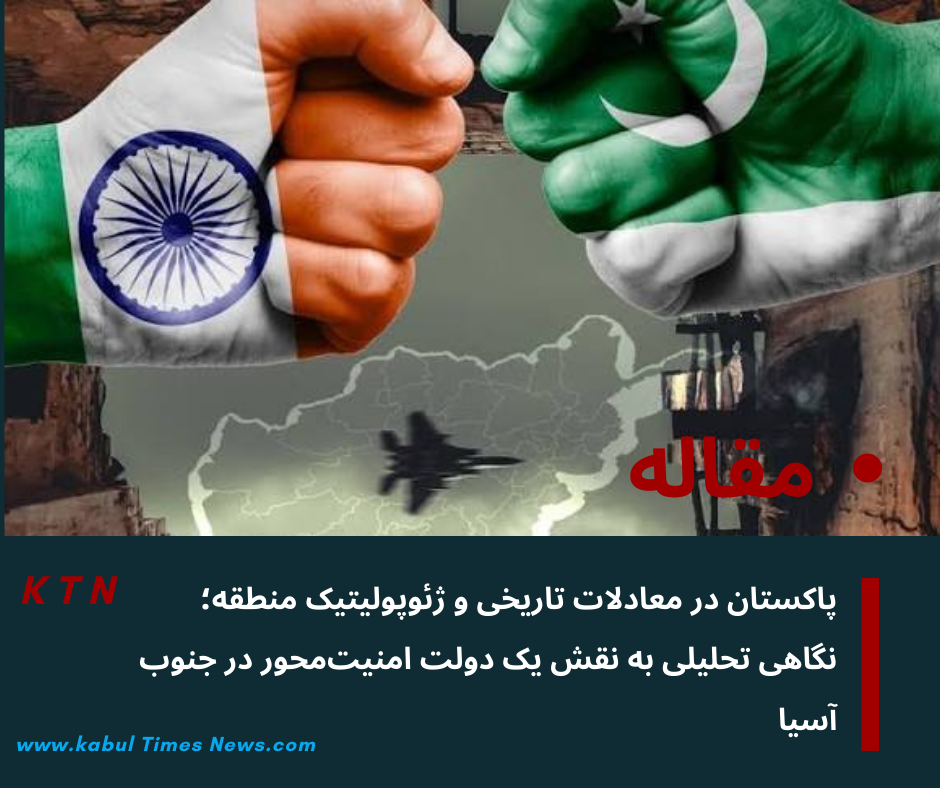
The Indian subcontinent and the South Asian region have long been one of the most complex political, ethnic, and geopolitical centers of the world. The emergence of the modern state of Pakistan in the mid-twentieth century opened a new chapter in regional equations.
Since its inception, the country has played a prominent role in the security developments of South and Central Asia and has had tense relations with its main neighbors, especially India and Afghanistan.
This article attempts to examine the roots of these tensions and their consequences for regional stability from a historical and analytical perspective and to question the future of Pakistan's place in the new multipolar world order.
The emergence of Pakistan and the legacy of conflict in South Asia?
The state of Pakistan emerged in 1947, coinciding with the end of British colonialism and the partition of the subcontinent.
This hasty birth, without a lasting resolution of border, identity, and political disputes, sowed the seeds of deep animosities in the region.
The first and most important crisis was the conflict with India over Kashmir, a crisis that led to several official wars and decades of military tension.
From the very beginning, the power structure in Pakistan was shaped in such a way that security and military institutions gained a dominant role in domestic and foreign policy, which led to the securitization of foreign policy and made the path of sustainable diplomatic engagement with neighbors difficult.
The tense relations between Pakistan and Afghanistan, Pakistan's relations with Afghanistan have also always been mixed with distrust. Border disputes, the Durand Line issue, political and security interventions, and the role of proxy actors have caused this relationship to take on a less sustainable cooperative color.
In recent decades, Afghanistan has become an arena of regional and trans-regional competition, and Pakistan, as one of the key players in this equation, has been repeatedly accused of seeking to secure its own strategic depth instead of contributing to stability; A policy that ultimately not only did not benefit itself, but also posed serious challenges to Pakistan's own security and sustainable development.
Multipolar World and Pressure on Security-Oriented States
Today's global order is gradually moving away from unipolarity and towards multipolarity.
In such circumstances, regional countries tend to reduce the role of extra-regional powers and foreign military presence and think about indigenous mechanisms of collective security.
States that have based their foreign policy mainly on the logic of confrontation, proxy war, and military means are facing increasing regional and international pressure in this new order. Pakistan is no exception to this rule, and the future of its position in the region depends on the extent to which it transitions from security-oriented policy to diplomacy, economic cooperation, and regional integration.
The Role of Nations in Redefining the Future of the Region
History has shown that nations are the main victims of the confrontational policies of states.
The people of Afghanistan, India, and Pakistan have paid the highest price for wars, tensions, and chronic instability.
The sustainable future of the region lies not in the elimination or destruction of a state, but in changing policy paradigms and moving from the logic of hostility to the logic of cooperation.
Afghanistan can and should become a civilizational, economic, and cultural bridge between South and Central Asia, instead of an arena of power competition; a role that, if realized, will benefit not only Afghans but the entire region.
Conclusion
The question of Pakistan’s future is in fact a larger question about the future of the regional order in South and Central Asia.
No country collapses or flourishes in a vacuum; The fate of states is tied to the extent to which they adapt to new global realities, embrace regional cooperation, and distance themselves from hostile policies.
If the region is to break free from the vicious cycle of violence, instability, and foreign intervention, the path lies not in eliminating one actor but in redefining roles, accepting historical responsibility, and building an order based on mutual respect and shared interests.
The emergence of the modern state of Pakistan in the mid-twentieth century opened a new chapter in regional equations.