It is vital for the Islamic regime to quickly find a strong successor for Khamenei.
Background
Succession to Khamenei: While there is no designated successor for the Supreme Leader, the Islamic regime in Tehran needs to swiftly appoint a new leader for its survival. Therefore, the usual procedure for this process will likely not be followed precisely. Which names are currently circulating?
Floris van Straaten
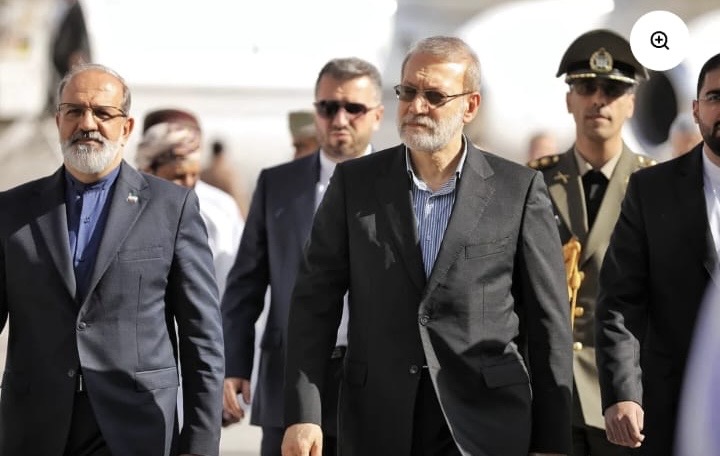
Ali Larijani, former Speaker of Parliament and former IRGC commander (gray beard, dark glasses), has emerged as a close advisor to Khamenei and is frequently mentioned as a potential successor.
There is no undisputed crown prince ready to take the place of the man who has led Iran for the past 36 years. Not that the 86-year-old Khamenei—who was killed in an Israeli-American attack on Saturday—ever seriously considered retirement, but—unlike his predecessor Ruhollah Khomeini—as far as we know, he had never explicitly designated who should succeed him. Given that Khamenei held significantly less authority than Khomeini at the time of his own appointment, it is also questionable whether his choice would be accepted without challenge by other high-ranking Iranian officials.
According to Iranian sources, Khamenei had previously provided a list of three names of men who could potentially lead during last summer’s Israeli and American attacks on Iran, when he was forced to take refuge in an underground bunker. Those names have never been disclosed. However, the presence of his son Mojtaba on that list has been denied, even though his name had been repeatedly mentioned in the past. Mojtaba Khamenei (56 years old) is not a prominent cleric, and moreover, he has been discredited in the eyes of many due to reports of shamelessly enriching himself through corrupt practices.
Analysts are also uncertain whether Iran will once again appoint a hardline conservative cleric as leader—someone who, like Khamenei, clings to the Islamic regime at all costs, increasingly unprecedented and repressive—or whether a more secular and pragmatic leader will emerge, one even more closely tied to the powerful Islamic Revolutionary Guard Corps (IRGC)—or even an IRGC general himself. However, it is highly unlikely that a secular liberal would immediately take the helm and pursue reconciliation with the West or transform Iran into a modern democracy.
Since the 1979 Islamic Revolution, the Supreme Leader—following Khomeini’s vision—has held immense power in Iran. He not only appoints the highest judges and commanders of both the regular army and the powerful IRGC, but he also has the final say in all major decisions across every domain, from economic policy to foreign affairs.
The three-member committee searching for a new leader
Officially, after the death of the Supreme Leader, a committee consisting of the President, the Head of the Judiciary, and a senior cleric examines the successor. On Sunday it was announced that Alireza Arafi, a 66-year-old cleric, will join this three-member group. The other members are the relatively moderate President Masoud Pezeshkian and the Head of the Judiciary, Gholam-Hossein Mohseni-Eje’i.
The candidate they propose must be approved by the Assembly of Experts. However, the 88 members of this body—including their loyalty to the Islamic regime—are carefully vetted by the Guardian Council, which in recent years has itself been appointed by Ayatollah Khamenei.
The question remains whether this procedure will be strictly followed even in wartime. Now that Khamenei, the great helmsman, is gone, it is vital for the Islamic regime to quickly appoint a new, strong leader. Vali Nasr, an Iran expert from Johns Hopkins University, stated in the New York Times last June: “The highest priority is the survival of the regime.” And that requires a degree of flexibility. In the case of Khamenei himself in 1989, the rules were not fully observed either—he was not yet a prominent cleric at the time, but this was resolved by his hasty promotion to Ayatollah.
The Associated Press reported on Sunday evening that finding a new Supreme Leader could happen quickly, possibly within two days.
The spiritual leader who brought poverty, repression, and war to his country alienated his regime from the Iranian people. Partly due to Khamenei’s advanced age, there has been much speculation in recent years about who the most promising candidate would be. For a while until 2024, it seemed that the candidate would be Ebrahim Raisi, a hardline conservative cleric whom Khamenei himself had appointed as president—a position Raisi had held for several years. But Raisi, who was never popular among the people, disappeared in a fatal helicopter crash.
In recent months, the name of Ali Larijani (67 years old), the former Speaker of Parliament who also has very good connections within the IRGC and once served as a commander there, has been mentioned more and more frequently. Analysts note that Larijani, known as a pragmatist, has in recent years been sent by Khamenei on highly sensitive missions, including abroad. For example, he traveled to Oman multiple times to discuss Iran’s involvement in nuclear negotiations with the United States on Khamenei’s behalf. Oman has acted as a mediator in these matters.
In January, when Khamenei brutally suppressed protest demonstrations, it was reported that Larijani was serving as the Supreme Leader’s closest advisor. The United States partly for this reason placed him on its sanctions list. Larijani comes from a family of high-ranking clerics and has repeatedly led Friday prayers in Tehran on behalf of Khamenei. He has also worked as a professor of philosophy. According to The Economist, his specialty is notably the German Enlightenment philosopher Immanuel Kant.
One of his possible rivals is Mohammad Bagher Ghalibaf, the current Speaker of Parliament, who is three years younger. He is a former pilot and former commander of the IRGC Aerospace Force. He also served for years as mayor of Tehran. He is considered conservative but relatively pragmatic. However, Ghalibaf lacks serious clerical credentials. Like Mojtaba Khamenei, there is more than a whiff of corruption surrounding him. Reports indicate that his son left for Canada with a substantial amount of money.
Mohammad Bagher Ghalibaf, Speaker of Parliament (right), is considered a possible rival to Ali Larijani, Khamenei’s trusted figure.
Hassan Rouhani, the former president who also has a clerical background, is occasionally mentioned. However, many conservatives consider him too liberal. Rouhani was one of the architects of the nuclear deal with the United States, which was unilaterally withdrawn by Trump in 2018.
If the Assembly of Experts prefers to once again see a genuine cleric at the top of power in Iran, Alireza Arafi himself could become a candidate. He serves on both the Assembly of Experts and the Guardian Council and leads Friday prayers in the holy Shiite city of Qom, where Ayatollah Khomeini also resided for many years. He too worked closely with Khamenei. However, placing such a relatively unknown cleric with limited political experience at the head of an increasingly shaky Islamic regime would be a major gamble for the system.
It is vital for the Islamic regime to quickly find a strong successor for Khamenei.