Why is Afghanistan still poor despite its rich natural resources? A comparative analysis with Norway and the United Arab Emirates
Kabul Times News-16-04-2026
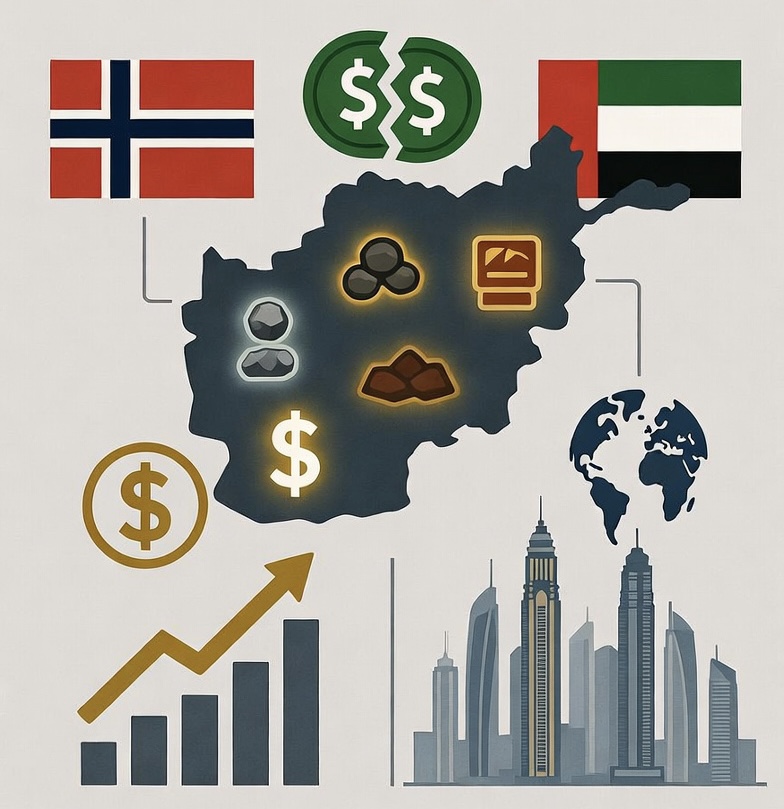
Afghanistan is one of the richest countries in the world in terms of mineral reserves. The potential value of its undiscovered mineral resources is estimated at between $1 and $3 trillion. The country has large reserves of lithium (equivalent to the world's largest reserves), copper (more than 60 million tons in the Aynak copper mine), iron (about 2.2 billion tons in Haji Gak), beryllium, rare earth elements, gold and other vital minerals. However, more than half of the population (about 45-60 percent depending on the indicators) lives in extreme or multidimensional poverty, more than 21 million people need humanitarian assistance and the economy faces profound challenges of isolation, sanctions and instability.
This paradox is a clear example of the “resource curse” phenomenon: the presence of natural resources alone is not a factor in development; the quality of institutions, political stability, and smart resource management are the main determinants.
Main causes of poverty despite abundant resources
• Political instability and prolonged wars: Decades of conflict have led to the destruction of infrastructure, the flight of human capital, and the weakening of state capacity.
• Weak institutions and corruption: Mining is often non-transparent or illegal. Mining revenues have increased under the Taliban regime in recent years (reportedly between $100 million and $360 million in different sectors), but their distribution is not transparent and is often spent on current needs rather than development.
• Lack of infrastructure: The lack of roads, electricity, processing industries, and technology has made economic exploitation very costly.
• Geopolitical situation: Competition between regional and global powers has hindered sustainable stability.
• Social challenges: Low literacy levels, severe social constraints (especially for women), and traditional structures have weakened human capital.
Comparative analysis: Lessons from Norway and the UAE
• Norway: The Government Pension Fund Global was worth 21,268 billion Norwegian kroner (about $2.1 trillion) at the end of 2025, with a return of 15.1%. With transparent democratic institutions, effective anti-corruption efforts, and long-term planning, the country has saved oil revenues for future generations and avoided the “Dutch disease.” The result: one of the highest levels of human development in the world.
• United Arab Emirates: The non-oil sector accounted for more than 77 percent of GDP in 2025, growing by 5.1 to 6.1 percent. The UAE economy grew by about 5 percent in 2025, and growth is forecast at 5.6 percent in 2026. With an efficient centralized government, investment in tourism, trade, technology, and economic diversification, the country has drastically reduced its dependence on oil and become a global hub.
In contrast, Afghanistan lacks stability, strong institutions, transparency, and long-term planning. The experience of these two countries shows that resource management, security, and effective institutions are the key factors for success.
Conclusion
Afghanistan’s poverty is not due to a lack of resources, but rather a combination of chronic instability, weak institutions, corruption, lack of infrastructure, and isolation. Comparisons with Norway and the UAE emphasize that without deep institutional reforms, political stability, and transparent governance, even the richest reserves (such as lithium for green energy) cannot become engines of development.
Key recommendations:
• Strengthening government institutions and fighting corruption
• Urgently investing in infrastructure and processing industries
• Establishing a transparent legal framework for mining contracts with independent oversight
• Focusing on education and human capital development (with an emphasis on women’s inclusion)
• Creating a safe environment to attract sustainable foreign investment
This summary is based on interdisciplinary analysis and up-to-date statistics from reputable international sources (such as USGS, World Bank, Norway Fund report, and UAE Central Bank). Without fundamental structural changes, the “resource curse” in Afghanistan will persist and a historic opportunity to exploit vital minerals will be missed.
Why is Afghanistan still poor despite its rich natural resources? A comparative analysis with Norway and the United Arab Emirates