Tajikistan returns to ancestral script; official start of government publications in Persian script
Monday – Kabul Times News | Zahir Jahesh
The Republic of Tajikistan, continuing the process of restoring its historical and cultural identity, has taken a new step towards returning to the Persian script; a move that is considered a turning point in the country’s contemporary history by cultural and political observers.
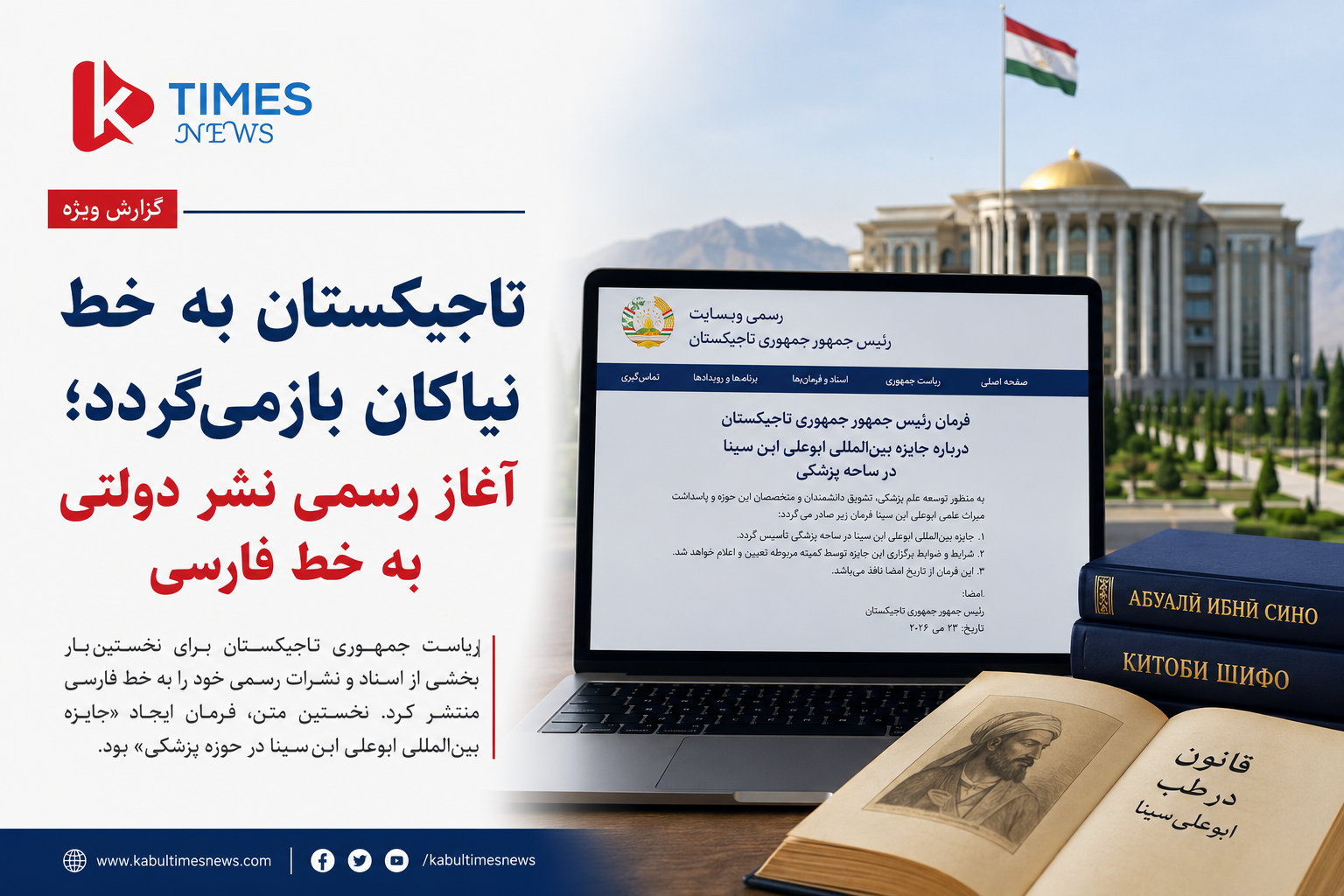
On May 23, 2026, the official website of the President of Tajikistan published some of its official publications and documents in Persian script for the first time. The first text published was the decree of the President of Tajikistan on the establishment of the “Abu Ali Avicenna International Prize in Medicine”; an award for which doctors and medical researchers from different countries of the world are to compete.
This move comes at a time when, over the past decades, Cyrillic script was used as the official script of Tajikistan, and the use of Persian script was mainly limited to cultural and academic circles.
The gradual return of Persian script to official institutions
Cultural experts believe that the official publication of government texts in Persian script is not just a change in writing, but is part of Tajikistan’s cultural policy to strengthen historical ties with the Persian-speaking civilizational heritage.
Simultaneously with the publication of this decree, widespread reactions were formed on social networks and regional media. Many Tajik writers, poets, and cultural activists described this action as a “return to the script of our ancestors.”
This development is a continuation of a trend that has gradually taken shape in Tajikistan in recent years. Previously, the official newspaper “Jumhurit” had published some of the material in Persian script in its Nowruz special issue titled “Arya Nameh,” an action that was considered unprecedented in the country’s official media after decades.
Avicenna; The axis of scientific and cultural diplomacy
According to analysts, the choice of the name Abu Ali Ibn Sina for the first decree published in Persian script carries a special cultural and identity message.
Ibn Sina, a renowned scientist and physician in the Islamic world and one of the most prominent figures of Persian civilization, has become an important axis in regional cultural competitions in recent years. According to observers, by highlighting this scientific figure in the form of an international award, Tajikistan is trying to establish the historical and cultural position of the Persian-speaking region in the scientific and civilizational arena.
Cultural ties beyond borders
In recent years, cultural convergence among Persian-speaking people in the region has also increased. After the developments in Afghanistan in 2021, many Tajik poets and writers published their messages and works in Persian. Also, the book "Letter to Panjshir", including poems and articles by Tajik writers, was published in both Persian and Cyrillic scripts and had a wide impact in regional cultural circles.
Analysts believe that the current trend in Tajikistan could pave the way for the expansion of the teaching and use of the Persian script in schools, universities, and cultural institutions in the country in the coming years.
Future Outlook
Although Cyrillic is still the official script of Tajikistan, the increasing presence of the Persian script in the media, cultural publications, and now in government documents, shows that the country’s cultural policy is on the path to gradually reviving its historical and linguistic heritage.
Many observers see the Tajik government’s recent move not only as a cultural development, but also as part of the country’s soft diplomacy in Central Asia; a diplomacy that relies on historical identity, a common language, and the civilizational heritage of the Persian-speaking world.
Tajikistan returns to ancestral script; official start of government publications in Persian script