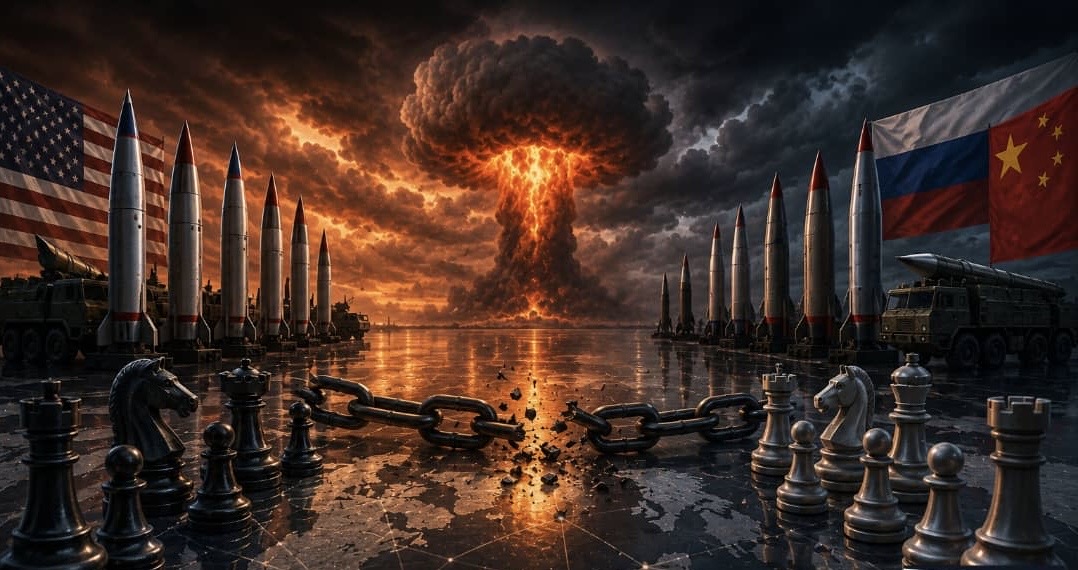
The world on the brink of a new nuclear arms race.
Kabul Times News | 2026-05-14
Is the nuclear competition between the great powers threatening the world again?
While the world is still struggling with the consequences of wars and geopolitical crises, there are worrying signs of the return of nuclear competition between the great powers; a competition that could plunge global security into an unprecedented stage of instability.
A newly published analysis by Chatham House warns that the weakening of arms control agreements, intensifying geopolitical competition and the decline in trust between world powers have seriously increased the risk of starting a new nuclear arms race.
⸻
Why has the risk of nuclear competition increased again?
Experts believe that several important developments in recent years have shaken the global nuclear order. The most important factors are:
* Weakening of international arms control agreements;
* Increasing tension between major powers;
* Return of power politics and geopolitical wars;
* Development of advanced military technologies;
* Declining trust and transparency between countries.
According to this analysis, the nuclear deterrence structure, which had provided some stability over the past decades, is now facing serious challenges.
⸻
Competition between the United States, Russia and China; the axis of the new crisis
The growing competition between the United States, Russia and China has now become the most important factor in global security concerns.
The dimensions of this competition include the following:
1. Modernization and expansion of nuclear arsenals;
2. Development of advanced and hypersonic missiles;
3. Competition in deterrence technologies;
4. Strengthening missile defense systems;
5. Increasing military presence in sensitive areas of the world.
The analysis emphasizes that any escalation of tensions between these powers could increase the risk of miscalculation and unintended conflict.
⸻
The gradual collapse of the arms control architecture
Over the past decades, international agreements have played an important role in reducing the risk of nuclear war; but many of these agreements are now either weakened or have lost their credibility.
The consequences of this situation include:
* Reduced military transparency;
* Increased misunderstandings between powers;
* Increased risk of miscalculation;
* Increased likelihood of a full-scale arms race.
Experts warn that without effective arms control frameworks, the world will enter a more dangerous era.
⸻
New technologies; a threat beyond the nuclear bomb
Today's danger is not limited to traditional nuclear arsenals. Emerging military technologies can also undermine the world's strategic stability.
The most important technologies of concern include:
* Military artificial intelligence;
* Hypersonic missiles;
* Cyber warfare;
* Automated military systems;
* Space technologies.
According to analysts, these technologies reduce decision-making time in crises and increase the likelihood of unwanted conflicts.
⸻
How can a new nuclear race be prevented?
The published analysis suggests several key strategies to prevent the escalation of the crisis:
1. Revival of arms control agreements;
2. Increased dialogue between world powers;
3. Creation of confidence-building mechanisms;
4. Management of competition in military technologies;
5. Strengthening international institutions;
6. Preventing the proliferation of nuclear weapons.
⸻
Global cooperation; A Security Imperative
Experts emphasize that no country can manage the nuclear threat alone. In a world where crises are rapidly taking on international dimensions, cooperation between powers is more important than ever.
⸻
Summary
The Chatham House analysis warns that the world is once again approaching a stage where nuclear competition could become one of the most serious threats to international security.
The most important conclusions of the report are:
* Intensifying competition between great powers;
* Weakening arms control agreements;
* Increasing risks from new military technologies;
* Increasing risk of miscalculation;
* The need for global cooperation to prevent crisis.
With global tensions on the rise, the future of international security will depend more than ever on diplomacy, trust-building and cooperation between powers.
The world on the brink of a new nuclear arms race.