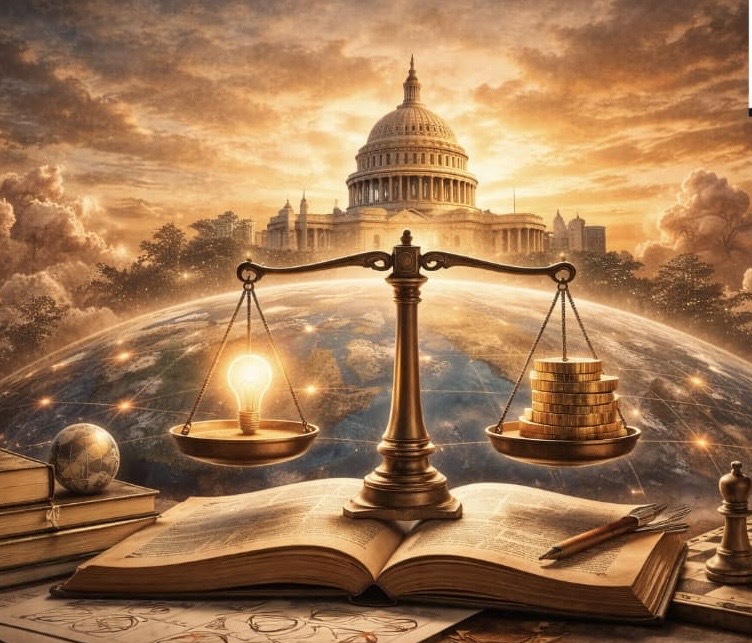
* Politics; The link between power, thought and collective destiny! The first part * What is politics and how should it be understood *? Before we reduce politics to events, elections, governments, or media conflicts, we must ask ourselves: What is politics in principle? Is politics merely a competition for power? Is it the only management of the status quo? Or a particular way of regulating reality based on a certain view of man, society and the future? To answer, we must start with the definition; A definition that raises politics from the level of everyday use to its conceptual level. * Politics; From prudence to orientation based on belief *: The word "politics" is derived from the root "sass, jesus" meaning tact and administration. But tact in itself is not enough; Because every measure is done from within one point of view. Accordingly, politics can be formulated as follows: Politics is the conscious observance, regulation and orientation of public affairs from within a certain angle, belief or idea, so that the power and resources of society are used in the realization of that basis. This definition has several basic layers: observance and regulation of affairs and management element of special angle or belief → basic element and worldview of public affairs → distinction from the individual sphere of power and resources → tools of realization of the historical horizon → long-term consequences and the position of society in the future in the future in This framework is not a neutral policy. No policy is formed from an intellectual point of view. Even the claim of "neutrality" arises from a theoretical assumption. Politics in the general and specific sense; A concept in two areas: politics in the general sense refers to the regulation of affairs; Whether at the individual level or in a small social range. Every person who organizes his life, on a limited level, uses a kind of tact. But politics in a particular sense — which is the main topic of this discussion — relates to the regulation of public affairs from within a given intellectual basis; Where decisions affect collective destiny and shape the power structure. The difference between these two levels is in three things: the scope of influence - individual versus collectively, the role of public - personal versus structure - historical outcome - limited versus the determinant of the position of a society. This is a tactic. But when a government defines its economic model as “free market”, “distributive justice” or “economic independence”, it is policy; Because the intellectual angle determines how to use the power and the future direction of society. * Politician; Carrier of direction and intellectual angle *: In this context, a politician is someone who has a role in determining and applying this intellectual angle in the public sphere. He is not merely a manager; It carries one direction. The manager can make the existing structure more efficient; But the politician determines what this structure should serve in the service. For example: The manager asks: How to balance the budget? The politician asks: should the priority of the budget be social welfare, strengthening military power or infrastructure development? This second question is a political one. Because it is related to the point of view and historical direction. Politics in the classical tradition and in the modern world; From justice to power *: In the classical tradition, politics was linked to virtue and justice. The organization of collective life was based on an idea of public good. In that view, politics was a tool for achieving the desired order. In the modern world, politics was defined more and more with the government, national interests and balance of power. The element of power became more prominent and the calculation of facilities and limitations became the center of attention. However, even modern politics is not devoid of opinion. Every state, whether consciously or unconsciously, operates from within an image of man, society, and his place in the world. * Politics; Between Reality, Power, and Historical Horizon: Politics is not the only reaction to reality; It is the interpretation of reality from within a worldview. political reality is not crude; Rather, it is always understood and adjusted in a conceptual framework. If societies consider themselves subject to world order, their policy is formed within the framework of the same order. If he defines himself as having a historical mission, his policy will have a different direction. Hence: politics is a bridge between the present and the future; Between existing power and the desired position. Every political decision is a step in defining the historical position of a society; Whether this definition is conscious or uninformed. *Summary of this section* In this formulation: Politics is not just the administration of affairs; Rather, the administration of public affairs is clear from within an intellectual angle; The politician is the bearer of this angle and direction; And politics ultimately determines the historical position of a society in relation to power and the future. On this basis, any discussion about the analysis, understanding, or evaluation of policy must first be returned to the intellectual basis and the perspective of it; Because without knowing the basis, the nature of politics cannot be understood.
* Politics; The link between power, thought and collective destiny!