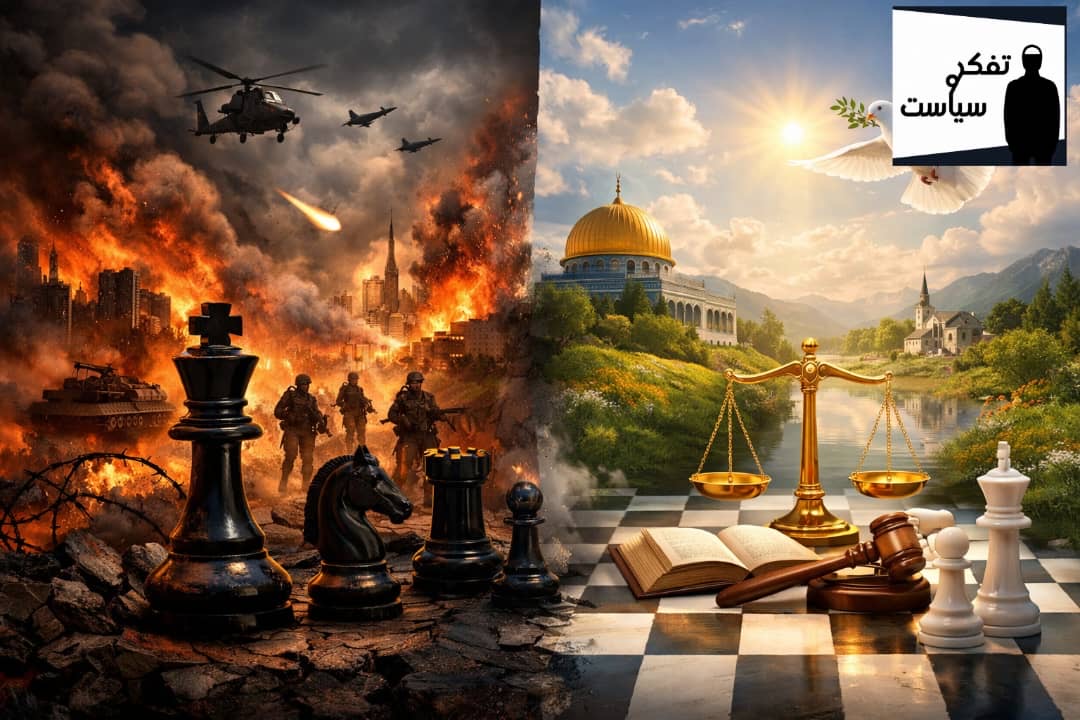
Global Order or Order of Powers? When Justice Becomes a Victim of Politics!
In global politics, words are not merely tools for describing reality; they are themselves part of the battlefield of power. Concepts such as “legitimacy,” “aggression,” “security,” and “legitimate defense” are, in many cases, defined not according to fixed legal or moral standards, but within the framework of the interests of great powers. For this reason, an action that is called “defense” in one situation is labeled “aggression” in another. This state of affairs shows that in the contemporary international system, the competition among powers is not limited to military and economic arenas; it also rages in the field of narrative construction and the definition of concepts.
Legitimacy; a Concept in the Shadow of Power:
In many global crises, the legitimacy of military and political actions is determined not by universal principles of justice, but by the position of the actors within the structure of power. When great powers or their allies carry out military actions, these are often justified with titles such as “defense of regional security,” “preemptive action,” or “preserving stability.” But if a similar action is taken by other states, the very same act is quickly described with terms like “destabilization,” “threat to global security,” or “aggression.”
Examples of this kind of narrative framing can be observed in some recent regional developments; where military strikes by certain powers or their allies are presented as “defensive action,” but the response of the other side is immediately labeled “aggression.” This pattern is even visible at the diplomatic level: in some official statements, emphasis is placed on the “aggressive actions” of one side, while the actions of the other side are justified as legitimate defense or necessary measures. These examples demonstrate that words in global politics are not just descriptive tools; they are instruments for shaping public opinion and consolidating the narratives of the powerful.
Double Standards in Contemporary Experience:
The phenomenon of double standards is not limited to a single crisis; it has been visible in many major events of recent decades.
In the war in Ukraine, Western governments quite rightly speak of “Russian aggression” and emphasize the need to defend national sovereignty. Yet the same level of sensitivity is not always observed in other cases.
In Gaza, war, siege, and humanitarian crisis have continued for years; yet many governments use cautious language to describe this situation and rarely frame it as “aggression” or “widespread violation of human rights.”
Similar examples from the past are plentiful. The U.S. invasion of Iraq in 2003 was justified by claims of weapons of mass destruction and the necessity of “preserving global security”—claims later proven false.
In Afghanistan, a long and devastating war was launched under the banner of “the fight against terrorism,” but in practice that slogan became a pretext for military occupation and justification of numerous operations and destruction that continued for two decades and ultimately ended without achieving the stated objectives.
These experiences show that in many cases, legal and moral concepts in the international system are interpreted in a way that aligns with the existing balance of power. In other words, in many crises, the real criterion is not justice, but power.
The Moral Crisis of the International Order:
The continuation of such double standards has profound consequences for the legitimacy of the global order. When fundamental concepts such as justice, legitimacy, or human rights are applied selectively, public trust in these concepts is eroded. In such circumstances, the international order becomes less a system based on shared human principles and more an arena for competition and conflict among powers.
While this situation may help preserve the dominance of certain powers in the short term, in the long run it leads to the erosion of the legitimacy of the entire international system. An order whose standards constantly shift and in which justice is subordinate to power will sooner or later face a crisis of legitimacy.
Political article