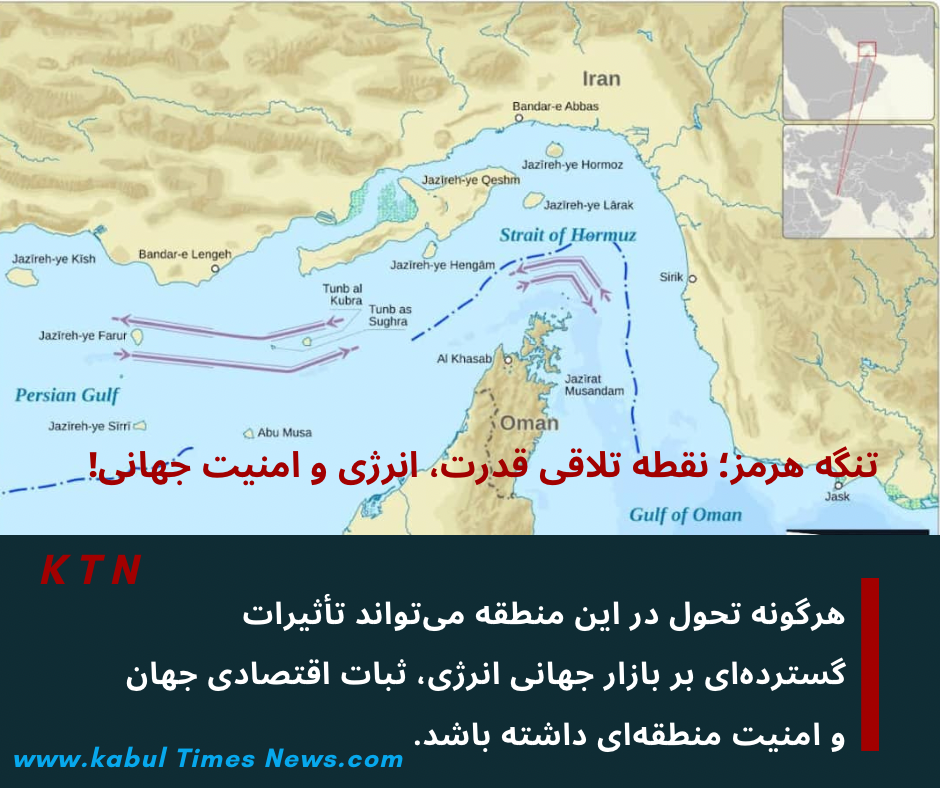
n the political geography of the world, there are certain points whose importance far exceeds their geographical size. The Strait of Hormuz, known in Persian as تنگه هرمز (Tang-e Hormuz), is one of the most prominent examples of such locations.
This narrow strait, which connects the Persian Gulf to the Gulf of Oman and then to the Indian Ocean, is in fact one of the most critical arteries of the global economy. Numerous studies in political, economic, and security fields show that any development in this region can have widespread impacts on the global energy market, worldwide economic stability, and regional security.
For this reason, the Strait of Hormuz is not merely a simple shipping route; it is considered one of the most sensitive geopolitical chokepoints in the world.
Geographical Location and Natural Features
The Strait of Hormuz lies at the mouth of the Persian Gulf, bordered by Iran to the north and Oman to the south. This geographical position makes it the only natural passage between the Persian Gulf and the open ocean.
Key geographical features include:
• Approximate length: about 160 km
• Width at the narrowest point: about 33 km
• Shipping lanes are extremely limited
This very limitation of navigable paths has made the Strait of Hormuz recognized as a strategic maritime chokepoint—a location where any disruption can severely affect global trade flows.
Economic Importance of the Strait of Hormuz
The most important factor behind the strait’s significance is its role in global energy transportation. A large portion of the oil and gas produced in the Persian Gulf region is exported to world markets through this strait.
According to global economic data:
• Approximately one-fifth of the world’s consumed oil passes through this route.
• A significant share of the region’s liquefied natural gas (LNG) is also transported via this passage.
• Millions of barrels of oil reach global markets daily through this chokepoint.
The main energy-exporting countries via the Strait of Hormuz are:
• Saudi Arabia
• United Arab Emirates
• Kuwait
• Iraq
• Qatar
• Iran
The majority of this energy is exported to major Asian economies such as China, India, Japan, and South Korea. For this reason, the security of the Strait of Hormuz is of vital importance to the global economy.
Geopolitical Importance
In geopolitical studies, the Strait of Hormuz is regarded as one of the world’s most critical pressure points of power.
Control over — or instability in — this strait can affect three major domains:
1. Global energy security
2. Stability of world financial markets
3. Power balance in the Middle East
Alongside the Strait of Hormuz, other key global chokepoints such as the Strait of Malacca and the Suez Canal also play important roles in world trade. However, the Strait of Hormuz holds special importance due to the enormous concentration of energy resources surrounding it.
Military and Security Importance
Because of its economic and geopolitical significance, the area around the Strait of Hormuz is one of the most militarized maritime regions in the world.
Multiple naval forces are present in this area, including:
• The Iranian Navy
• Naval forces of the Arab Gulf states
• The United States Navy fleet
This extensive military presence underscores the strategic security importance of the strait, as any disruption could rapidly escalate into a regional — or even global — crisis.
The Strait of Hormuz in Regional Political Equations
The Strait of Hormuz has played a major role in many Middle Eastern political crises. Rivalries among regional countries, as well as tensions between global powers, have repeatedly turned this strait into a focal point of international politics.
On many occasions, threats to restrict shipping through the strait have been used as a political pressure tool — precisely because its impact on the global economy would be rapid and far-reaching.
Scenario of Closing the Strait of Hormuz
One of the key topics in strategic analyses is the possibility of the strait being closed during a crisis.
If such a scenario were to occur, the consequences could be extremely broad:
• Severe shock to energy markets
• Rapid surge in global oil and gas prices
• Global economic crisis
• Economies heavily dependent on Persian Gulf energy would face intense economic pressure
• High probability of military intervention
Major powers would likely act to reopen the shipping route
For this reason, many analysts consider the Strait of Hormuz one of the world’s most sensitive flashpoints for potential crises.
Efforts to Reduce Dependence on the Strait of Hormuz
Given the geopolitical risks, some regional countries have attempted to develop alternative routes.
Examples of these efforts include:
• Oil pipelines in Saudi Arabia that transport oil to the Red Sea
• Pipelines in the United Arab Emirates that carry oil to the Gulf of Oman
However, the capacity of these alternative routes is still far from sufficient to fully eliminate global dependence on the Strait of Hormuz.
The Future of the Strait of Hormuz in Global Politics
Despite changes in energy markets and efforts to diversify energy sources, the Strait of Hormuz will remain one of the world’s most important geopolitical locations for decades to come.
Several key factors will sustain its importance:
• Continued global dependence on Persian Gulf oil
• Rising energy demand in Asian economies
• Competition among regional and global powers in the Middle East
• The critical role of maritime security in global trade
Conclusion
The Strait of Hormuz is not just a maritime passage; it is one of the main pillars of the global economic and security system.
Its importance can be summarized in three main dimensions:
• Economic: the world’s largest energy transit route
• Geopolitical: a highly sensitive point of competition among regional and global powers
• Security: one of the most critical strategic maritime areas in the world
Therefore, any development in the Strait of Hormuz can have consequences far beyond the Persian Gulf region — potentially affecting the entire global economy and security landscape.
(As of March 16, 2026, note that real-world developments have escalated dramatically since your original text was written: the ongoing U.S.-Israeli conflict with Iran has effectively closed or severely restricted the Strait, with shipping traffic near zero for most vessels, Iranian oil flowing selectively in limited “shadow” operations, and global oil prices surging well above $90–$100 per barrel amid widespread energy market shocks, stranded tankers, and calls for international naval intervention to reopen the route. The core analysis in your text remains highly relevant and prescient.)
Strait of Hormuz