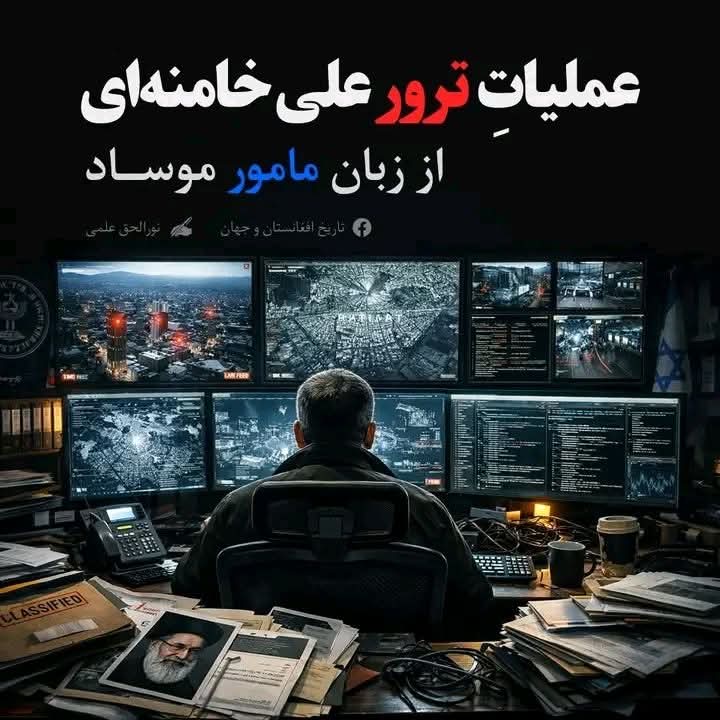
My name in the files is Agent Mossad, David. But it’s been years since I last remembered my real name. Five years ago, on a cold winter day in 2021, I received a call from the head of the Special Operations Division at Mossad headquarters in Tel Aviv. When I entered the room, the curtains were drawn and only a desk lamp was on. On the desk lay a thick file marked in red: “TOP SECRET – SPECIAL.” The division chief—a man with completely white hair whose name I never uttered—spoke without any preamble: “The next five years of your life go on this desk. Family, friends, everything you have—forget it all.” He opened the file. The first page contained only one photograph. A photo of Ayatollah Ali Khamenei, Supreme Leader of Iran. At that moment, I was just an operational agent with a few successful missions on my record. I had no idea I was about to become the hunter of a phantom that had been considered the most secure high-value target in the world for decades.
My room on the third floor of Mossad headquarters gradually turned into a brain that processed every piece of information related to Iran. In the early days, I only read. Khamenei’s file wasn’t a dossier—it was a library. He was born in 1939 into a clerical and militant family. His father, Sayyed Javad Khamenei, was a prominent cleric in Tabriz. But what gripped me most was his status among his followers. In Iran, he is called “Vali-e Faqih”—the representative of the Hidden Imam during the Occultation. Millions of people in Iran, Iraq, Lebanon, Bahrain, Yemen, and Afghanistan regard him as a divinely appointed leader. In the streets of Beirut, his portrait hangs beside Hassan Nasrallah’s. In Baghdad, Shia parties compete for his approval. In Sana’a, the Houthis fight in his name. I wasn’t facing a politician; I was facing a spiritual empire that had shattered geographical borders and extended Iran’s strategic depth to the shores of the Mediterranean and the Red Sea.
The first year of the mission was dedicated to mapping his security structure. The IRGC, the Quds Force, Ministry of Intelligence, Protection Unit of the Supreme Leader—each formed a layer in a multi-layered, highly complex system. I learned that his personal bodyguards were selected from the elite of the IRGC and underwent special training in VIP protection. They were trained to be ready to sacrifice themselves at any moment. His main residence was the Imam Khomeini Hosseiniyeh in Tehran, but he had numerous safe houses across the country. His movements were sudden, unscheduled, and unpredictable. Sometimes he stayed in one place for weeks; other times he changed locations several times in a single night. There was no pattern—or perhaps there was one we hadn’t yet deciphered. I had to read the minds of his guards, predict where and when his presence was most likely, and most importantly, find the point of vulnerability: a crack somewhere in those concentric security rings.
In the second year, I assembled a network of analysts, linguists, psychologists, and Middle East experts around me. We didn’t just study Khamenei—we studied Iran. Iran’s economy, politics, culture, power networks. I began to understand how he thinks. He is a cleric, but also an extraordinary strategist. He had learned how to navigate crises, how to outwait his enemies, and how to extract the maximum from minimal resources. During the eight-year Iran–Iraq War in the 1980s, he accumulated priceless experience. He knew how to run a country under sanctions and immense pressure. Every intelligence report that reached me completed the portrait of this superhuman in my mind: a man who had led a nation of 85 million for over three decades, survived two major wars, managed unprecedented sanctions, and built a regional alliance network that challenged the dominant power in the Middle East. Assassinating him wasn’t merely a military operation—it was total psychological warfare against an entire ideological current.
Early in the third year, I received game-changing intelligence from the CIA. The Americans had flown thousands of hours with their RQ-170 Sentinel and MQ-9 Reaper drones over Iran, capturing high-resolution images of military facilities and sensitive sites. These images were sent to me for analysis. But more important than satellite imagery were the achievements of Unit 8200 of Israeli Military Intelligence. They had penetrated parts of Iran’s Ministry of Communications servers and obtained data on the country’s telecommunications infrastructure. This gave us insight into how Tehran’s mobile network operated, where the blind spots were, and how to disrupt communications at critical moments. Slowly, we were weaving a web that would envelop Tehran without anyone noticing.
But our greatest intelligence victory came in that same third year. Unit 8200, in collaboration with Mossad hacking teams, succeeded in infiltrating the traffic camera network of Tehran. It was an engineering masterpiece. Thousands of cameras installed on streets, squares, and highways were connected to servers under our control. The feeds were encrypted and sent to our bases in Israel, where facial recognition and license-plate recognition algorithms immediately began processing them. My room was no longer a simple analysis office; it had become the command center of an unprecedented intelligence operation. We installed a giant screen on the main wall displaying live images from Tehran’s streets. I could watch police patrols, morning traffic, and sometimes even track security convoys heading toward unknown destinations. I had become the lord of Tehran’s streets without ever setting foot in the city.
The camera feeds poured into our servers in Israel and were processed in near real-time by our teams using the most advanced facial and license-plate recognition algorithms. We could monitor the movement of security vehicles, sudden route changes, and vehicle concentrations at specific points almost instantly. We had placed the pattern of his protection under a microscope—without him ever knowing. We knew what types of vehicles his guards used, how many lead cars were deployed, and how they cleared the route ahead of him. We were no longer chasing a ghost; we were approaching the role of an all-seeing god watching every move of the enemy through thousands of electronic eyes.
In early 2026, intelligence from the CIA—obtained through a highly valuable human source inside the Office of the Supreme Leader—reached me. We knew this source by the codename “Fasl” (Season). The information was critical: a highly confidential meeting with senior military and security chiefs of Iran was scheduled for the morning of March 7 in a government complex in central Tehran. More importantly, “Fasl” confirmed that the Supreme Leader himself would attend. He usually participated in such high-level meetings held inside Tehran. We knew the exact location: a secure building inside a heavily guarded compound. We also knew the exact time window: the meeting would begin at 10:00 a.m., and the Leader would most likely arrive between 9:45 and 10:15. This was the “golden moment” every analyst and operator dreams of.
The intelligence was immediately passed to the highest levels. Intense discussions took place in Tel Aviv and Washington. We already had a plan for a massive air campaign against Iran—codenamed “Epic Wrath”—designed for full-scale conflict. But this new opportunity changed everything. Why wait for all-out war when we could cut off the head of the snake with a single strike? A few days before the date, a phone call took place between Benjamin Netanyahu, our Prime Minister, and Donald Trump, the President of the United States. I don’t know the exact content, but we all understood the outcome: “Epic Wrath” was activated, but with one fundamental change—the execution time was shifted to the morning of March 7, coinciding with the Leader’s presence at the meeting. Green light was given at the highest possible level.
The night before the operation, I was at Ramon Airbase in southern Israel. The aircraft were ready in the hangars: F-35I “Adir” stealth fighters designed for penetrating advanced air defenses, and several F-15I “Ra’am” optimized for carrying heavy munitions. The pilots attended final briefings, reviewing precise 3D images of the target and ingress/egress routes. I was present at one of those briefings—not as a pilot. My superiors decided I should witness the fruit of five years of effort up close. I had to make sure everything went exactly according to plan and that the correct target was hit.
At 03:30 a.m. on February 28, 2026, the jets took off one after another and vanished into the dark sky. Silence inside the cockpit was broken only by engine noise and encrypted communications with other aircraft and command. Our route was pre-planned: entry from the northwest through Turkish and then Iraqi airspace, using valleys and low-altitude terrain to evade initial radars. The lead F-35s—built precisely for such missions—were several minutes ahead. Their task was to clear the path and suppress Iranian air defenses in the opening moments. Hours of silent, dark flight with eyes glued to screens displaying real-time data from satellites and surveillance drones over Tehran. We could see the city still sleeping beneath the clouds—but our target would soon awaken.
As we approached the Iraq–Iran border, the Mossad cyber operations team—stationed at ground bases—executed phase two. By penetrating deeper into Tehran’s telecommunications network, they managed to disable about a dozen mobile base stations in northern and central Tehran. Cell phones in that area either stopped working or gave busy signals. The goal was to create a “communications blackout zone” so that if any warning reached the guards from other intelligence services, they couldn’t quickly coordinate and move the target. At the same moment, the still-active traffic cameras showed the final movements: a convoy of several black SUVs with tinted windows, maintaining calculated distances, heading toward the target compound.
It was 09:32 Tehran time. We had entered Iranian airspace and were closing in on the target. Low altitude and high speed kept us hidden from most radars. The lead F-35s were closer to Tehran. In the command center, drone feeds showed the convoy entering the compound. The vehicles stopped in the inner courtyard. Faces couldn’t be seen, but we knew the patterns. He was in one of those vehicles. The meeting had begun. We were only minutes away from the specified time window. “Attack clearance granted” came through the encrypted channel. In the back seat of the F-15I, with my eyes locked on the targeting display, I was ready to witness the launch.
At 09:41:30, the lead F-35I aircraft released the first salvo of long-range, highly precise cruise missiles equipped with optical and radar seekers toward pre-designated targets—bunkers and air-defense command centers around Tehran—to blind the enemy’s eyes for the critical minutes ahead. Seconds later, it was our turn in the F-15I. The pilot pressed the red button on the control stick, releasing two “Rocks” missiles—bunker-busting munitions designed for sub-meter precision. From the thermal camera under the fuselage, I watched the missiles streak through the morning clouds toward a point in the heart of Tehran, thousands of kilometers away. In total, the air operation codenamed “Epic Wrath” lasted only 60 seconds. But in that single minute, hundreds of guided missiles and bombs from various aircraft rained down on designated targets in Tehran and several other cities. For us, however, only one target mattered.
Seconds after launch, the high-altitude surveillance drone feed showed the impact. First, dust and smoke from the initial explosion blocked the view. Then, as the smoke cleared, the image came through: the main building of the compound—our target—no longer existed. Large sections had collapsed, and fire was pouring from the windows. The convoy vehicles in the courtyard had vanished amid smoke and flames. We also received electronic and signals intelligence confirmation. Our listening devices, positioned safely in the region, registered complete communication blackout from the site. Not only communications—every vital signal emitted by electronic equipment inside the building was permanently silenced.
The return route was the same as the ingress, but faster and with full caution. Iran’s air defenses—partially destroyed, partially in shock—offered little reaction. Hours later, when we landed back at Ramon, I felt the exhaustion of five years in my bones. But the job wasn’t finished. The first hours after the strike were the most critical for confirmation. We continued monitoring emergency communications in Tehran. Total chaos. Ambulances were dispatched toward the area, but roads were blocked. Local officials were unable to receive orders from the center. The news we had been waiting for came about 24 hours later—from their own official mouths: Iranian state media announced the “martyrdom” of their Leader. My mission—the mission of “David”—had ended after five years. A man who was both a leader and an idea to millions no longer existed. But I knew that with this act, we had ignited the flame of a new war—one whose end none of us may live to see.
How Mossad assassinated the Iranian leader.