The international legal order is an illusion. “We remain vassals of America.”
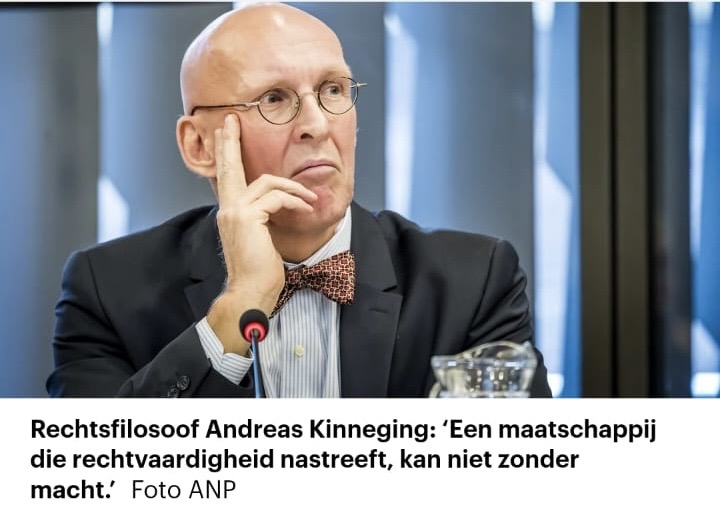
With the war in Iran, the international legal order has suffered another blow. Many experts regret this. Andreas Kinneging does not. This legal philosopher has never seen anything in it. According to him, might makes right. Yet he is not afraid of losing morality.
This article was written by Ludovic Dros. Published on March 6, 2026, at 2:13 p.m.
The United States, by attacking Iran, has trampled the international legal order. Donald Trump and Benjamin Netanyahu sent their military forces to an independent country without UN approval and wiped out its entire leadership. Earlier, Trump had violently abducted the president of Venezuela. Welcome to the new world order.
The newspaper’s editorial after the start of the recent war in Iran was clear: “States may not simply attack other countries. Period.” The new cabinet was less resolute: it understood the violation of the international legal order and therefore placed that order in perspective.
If the legal order disappears as a standard, won’t the world fall into a moral abyss?
Andreas Kinneging, professor of legal philosophy, answers: Not at all. He is even optimistic: “In times of crisis, the best people step forward. I have hope.”
Kinneging (64 years old) has taught generations of (law) students in Leiden. During this time, he has been regarded as a contrarian thinker. Recently, he has expressed appreciation for Trump, which is unusual among Dutch intellectuals. He once called himself a liberal, and the VVD was his political home. Since then, he has become conservative. He joined FvD (Forum for Democracy) but left it. Today, his ideas resonate mainly with JA21.
In his book Geography of Good and Evil (2005), which was named the best philosophical book of the year, and in Hercules at the Crossroads, he described his conservatism: the only way forward is the way back.
According to Kinneging, moderns (all thinkers after the Renaissance) have blind spots that the ancients (Western thinkers from antiquity to the Middle Ages) did not have. Kinneging’s ideas concern humanity and society. To avoid surrendering to pleasure and selfishness, the individual needs inner strength. And a society that strives for justice cannot exist without power.
Kinneging believes this last point is now being understood. “Too late and too little, but the good news is that politicians are waking up.”
The fear is: now that the rule of international law is collapsing, the last barrier against barbarism has disappeared.
“Behind your fear lies confusion. You don’t have to lose your morality right away, but you must realize that you can only achieve good through power. Thucydides said this 2,500 years ago: power, not law, is decisive. ‘The strong do what they can, the weak suffer what they must.’”
“Power is as fundamental a fact of life as death; we must come to terms with it, but we don’t want to know about it. Well, I do want to, but for most people, the current crisis is a reality check.”
To resolve conflicts, we had a legal system and dialogue. Without bombs.
“That was the prevailing belief. A quarter of a century ago, I was at a roundtable on war and peace with politicians from left to right. It was the time when armies were being dismantled year after year. I opposed it and said: war will always return.”
“I found that gathering very sad, because the time of armament was over. Now it was the time of consultation, dialogue, and international law. As if the Kingdom of God had arrived. But on the other hand, there will never be a paradise on earth.”
Now it seems that with Trump’s display of power, everything has turned into hell.
“He ignores international law, but his predecessors—Clinton, Bush, and Obama—did the same; they violated the sovereignty of other countries. The Chinese have been doing this for years, and so have the Russians.”
Isn’t this sovereignty worth defending?
“Twentieth-century international law was built on nineteenth-century international law with national sovereignty and the principle of non-intervention. This was an excellent solution against permanent war in the nineteenth century: if you do nothing bad to me, I won’t interfere in your affairs. It guaranteed the continuation of peace.”
“This came under pressure. First, because international law emerged from centuries of small-state rule. Those small European countries were no match for the ruthless display of power by a superpower. Second, technology has outpaced this right. The Iranian ayatollahs could build an atomic bomb sooner or later, which would have terrible consequences for the security of distant independent countries.”
Kinneging does not consider the international legal order a particularly modern phenomenon anyway. After all, it is a product of the modern era and ignores the insights of the ancients, thinkers from past centuries, such as Aristotle, Plato (“the two smartest men in history”), and Augustine.
It is no coincidence that all the thinkers Kinneging refers to during the conversation date from before 1600. Like the Florentine political philosopher and strategist Niccolò Machiavelli. “He saw the vital role of power. This insight has been forgotten and now we have to rediscover it. I just called someone at the Ministry of Foreign Affairs and asked if I could give a lecture on power politics.”
Where does morality fit into all this?
That is why we have Thomas Aquinas, the Italian philosopher and theologian who reflected deeply on war. He wrote on X (formerly Twitter) that, according to Pope Leo XIV, the attack on Iran is wrong because “the use of weapons” will only bring suffering and death. He believes dialogue is the only way.
“I wrote that he and his predecessors have completely forgotten the Catholic just war tradition of the Middle Ages and early modern period.”
“Yes, Thomas Aquinas was wiser than the pope. And I really consider this war just: it is for the common good, it prevents an illegal attack by Iran, and it is carried out with right intention. Intervention in Iran has a very strong moral component; just think of the freedom of the Iranians.”
The international legal order has been damaged. In January, former minister Jan Pronk advocated its revival in Trouw, if only because otherwise, as a small country, we will be crushed between the great powers.
Kinneging considers such a recovery operation both undesirable and unrealistic. “I assume that the West has a strong inclination toward justice. The prerequisite for that is: you have power; only then can you defend and enforce justice.”
“Europe is good at law and morality, but now it has become clear that law without power is powerless. In that case, there are three options. The first option is that we, as Beatrice de Graaf and many others suggest, form our own power bloc. It’s not pleasant to say, but it is impossible: internal divisions and diversity on this continent prevent the necessary unity for forming power.”
“The second option: continuing under the wing of Russia or China. I don’t think that’s attractive to anyone here. This leaves us with this conclusion: we were vassals of America and will remain so. Let’s accept that. It is the only feasible option.”
This brings us to the message Kinneging posted on X on January 4, after the United States abducted Maduro from Caracas: “The world is divided into spheres of influence. Venezuela is in the American sphere of influence. Ukraine is in the Russian sphere of influence. International law can do little or nothing to change this situation. It is good for Europeans to be more aware of this.”
This message could also have come from Alexander Dugin, the non-liberal thinker behind Putin, who divides the world into geopolitical power blocs, each with its own essence and value system. I think this is a moral statement that is common among journalists. I am not concerned with whether power blocs are allowed to have spheres of influence or not. I would prefer a world with 2,000 small countries like the Netherlands and Belgium that, after a small war with a few deaths, sit down at the table and make peace. But that’s not how it works: in the real world, three major power blocs have their spheres of influence. That is a fact, whether you like it or not.
A society that strives for justice cannot exist without power.